
This is an archived page.
The application window and the online portal are now closed and all remaining applications must be made to your local préfecture.
The basic information provided on this page however remains relevant.
The application window and the online portal are now closed and all remaining applications must be made to your local préfecture.
The basic information provided on this page however remains relevant.
Applying if you've been resident in France for less than 5 years and you work in another country
This page applies to you if you are resident in France but you work in another country, either as a frontier worker or on a different arrangement that doesn't fit into the EU's definition of a frontier worker.
|
What is a frontier worker? The status of frontier worker (frontalier) is strictly defined in EU law : it is someone who works in one country but returns to their country of residence every night or at least once a week. Many French residents work in Switzerland and Luxembourg, with some working in Germany and Belgium. As a non-French frontier worker you apply for your residence status and card in France, under the route described on this page, and for a permit to work in your country of work. This is covered by the Withdrawal Agreement. Your country of work is responsible for your social security and health cover - you and your family members will receive an S1 to ensure cover also in France (there are some local differences in health arrangements due to bilateral agreements). Working in the UK Many UK citizens live in France and are employed or self-employed in the UK under arrangements which may or may not fit the definition above - for example, you return to your home in France less than once a week, or you work in blocks of time then return to France for a longer period. You will pay contributions in the UK, which is also responsible for your health care and will issue you with an S1 to ensure than you and your family members are covered in France. If you are covered by the WA this arrangement will continue. You will apply for your residence status and card in France under the route described on this page. If you work both in France and in the UK, we suggest that you follow the appropriate route for those who work in France rather than the route described on this page. |
On this page we take you through the process of completing the online application form if you have been resident in France for less than 5 years and you are employed. We look at how to apply and what evidence you need to provide when you apply.
The previous 2 pages gave an overview and set the context for your application, and looked generally at the process of making your application. It's a good idea to read these first.
The previous 2 pages gave an overview and set the context for your application, and looked generally at the process of making your application. It's a good idea to read these first.
YOU ARE RESIDENT IN FRANCE AND WORK IN ANOTHER COUNTRY
Start your application
- Note that this section only relates to those who have been resident in France for less than 5 years. If you have lived here for 5 years or more, you will complete a different part of the application form and don't have to provide the details in this section. If you've been in France for 5 years or more and already hold a CdS permanent, go to this page. If you've been in France for 5 years or more and don't hold a CdS permanent, go to this page.
- It also relates only to those who are resident in France but employed or self-employed in another country. If you live and work in France, please go to this page.
- Begin your application by navigating to either the French or the English version of the application form on the French government website.
- Follow the instructions on the previous page to complete the introductory pages of your application if you haven't already done so, then return to this page.
Continuing your application
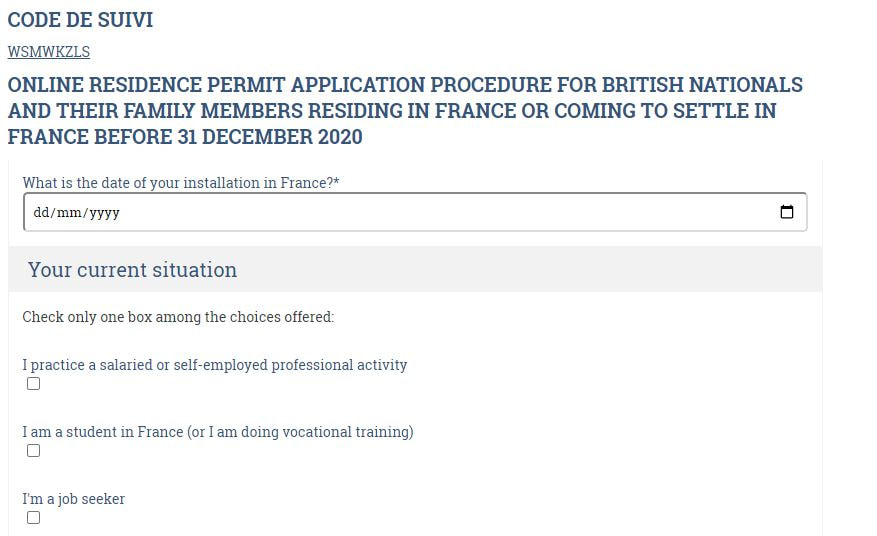
- First of all, you'll be asked for the date you first settled in France.
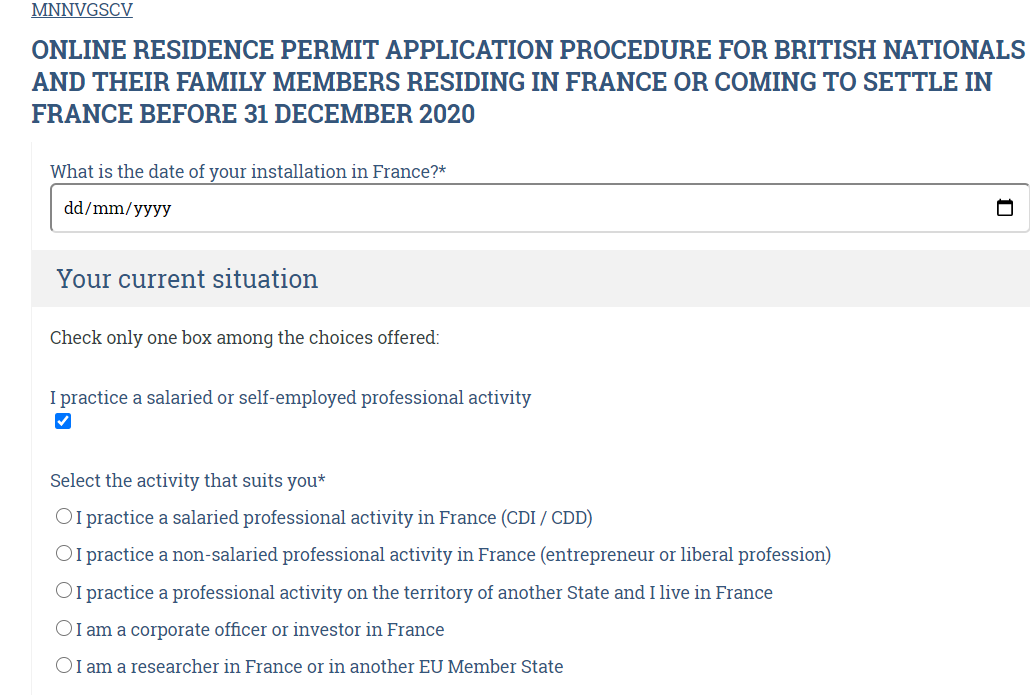
- Next, you'll be asked to choose your current situation. You'll need to select "I practise a professional activity on the territory of another State and I live in France". Then press Suivant.
|
|
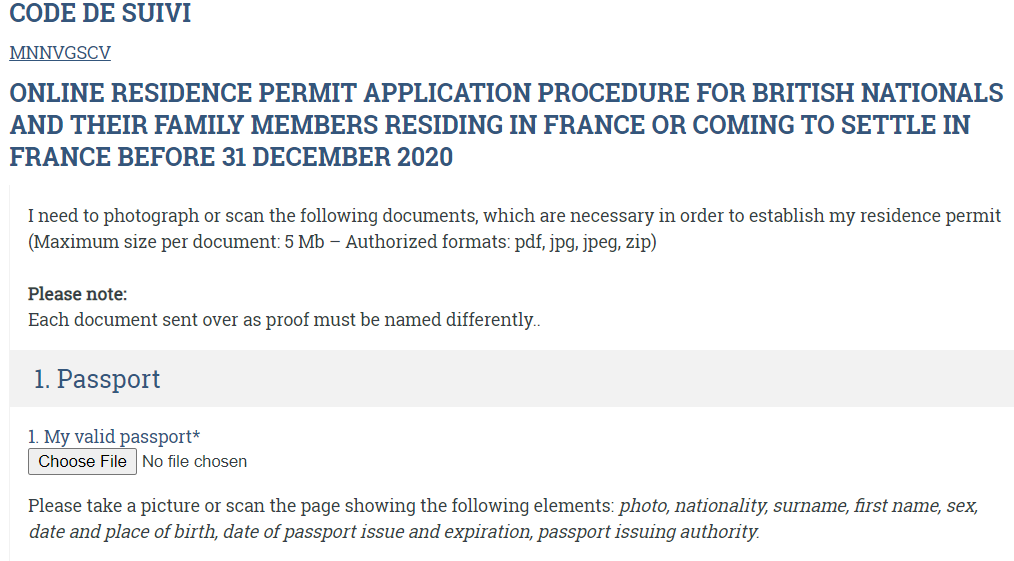
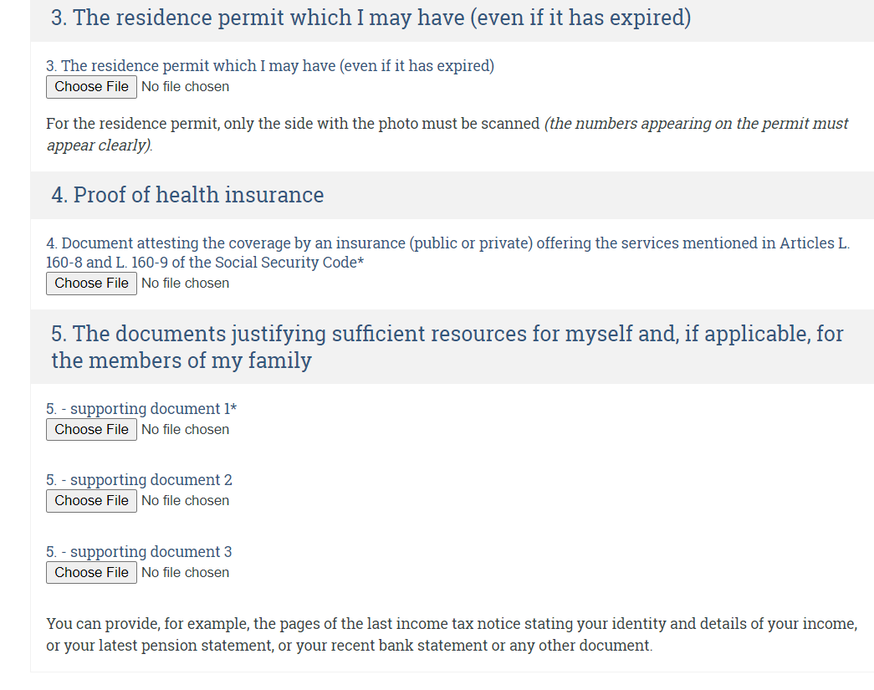
- The next page takes you through all the documents you need to upload, firstly your passport.
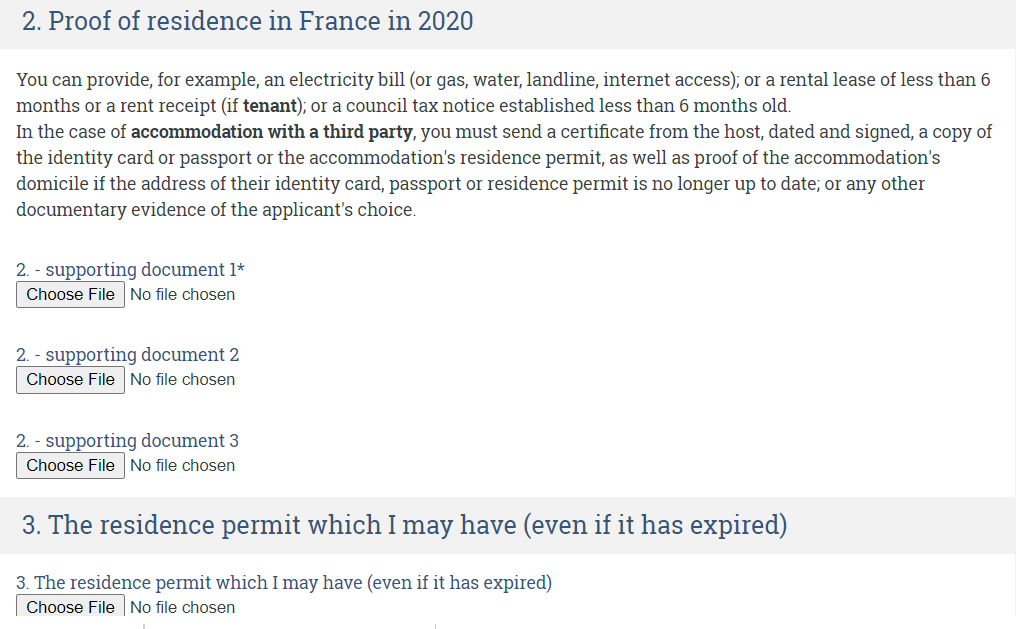
- After that, you'll be asked to upload proof of your residence in France in 2020 ((in other words, before the end of the transition period on 31 December 2025). Suggested proofs are a utility bill (electricity, gas, water, landline phone, internet) or a rental agreement or rent receipt or a taxe d'habitation bill that is less than 6 months old, although you can also use something else that proves your residence. You can upload several documents if you're not sure. If you live in someone else's house you'll need an attestation d'hébergement from the person who is accommodating you (dated and signed), along with a copy of their identity card or passport or residence permit, and proof of their address if the address on their identity card, passport or residence permit is no longer up to date or doesn't appear. You can find a model attestation d'hébergement here.
- You'll then be asked to upload a copy of the front of any residence card that you hold, even if it is expired. If you have a one year or a five year card, upload that here.
- Next you'll be asked for proof that you have health insurance. Specifically, you need to show that you have health cover that offers the "services mentioned in Articles L. 160-8 and L. 160-9 of the Social Security Code". These two articles list everything that is currently covered by the French state health care system; if you have private health insurance, in order for this to be accepted as 'comprehensive health insurance' for the purposes of your application it needs to include everything that the French system itself covers. You can find an English translation of these two articles here. If you have an S1 from the country in which you work, there is no issue as your S1 gives you full access to the French system, so you would simply need to upload a copy of your attestation (which you can download from your Ameli account page).
- Finally on this page you'll need to upload proof that you have sufficient resources for yourself, and for your family if you have one. Préfectures should not use a fixed, one-size-fits-all minimum income level to assess whether you have sufficient resources; instead they must assess each application individually, using the information you have provided. As in other EU countries they are provided with a guideline figure to help with the assessment. The guideline figure now confirmed in legislation published on 29 November 2025 is the basic level of RSA (revenu de solidarité active) for a single person, whatever your age or household composition. This is currently 565,34€ per month.
|
|
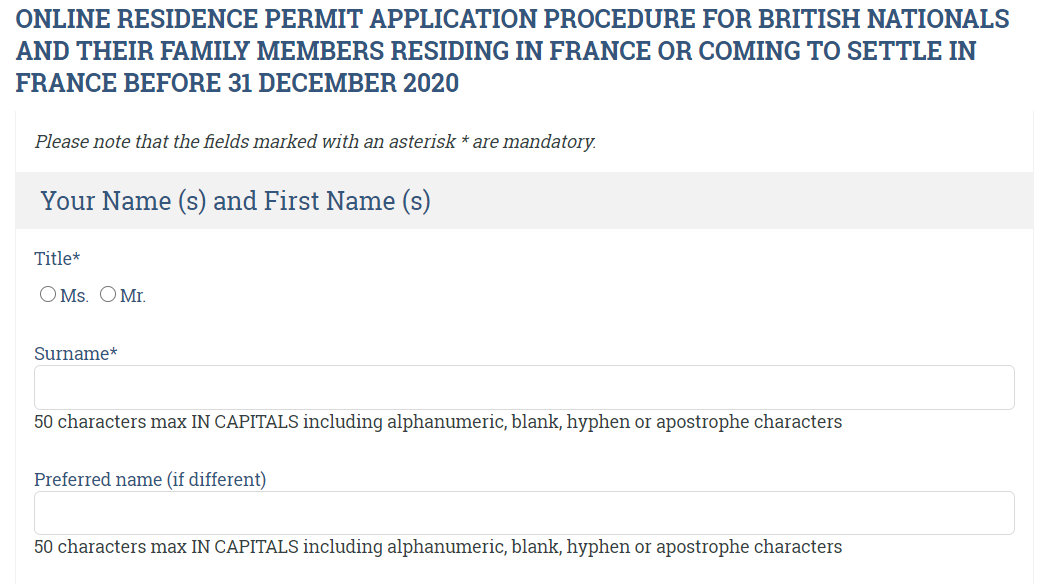
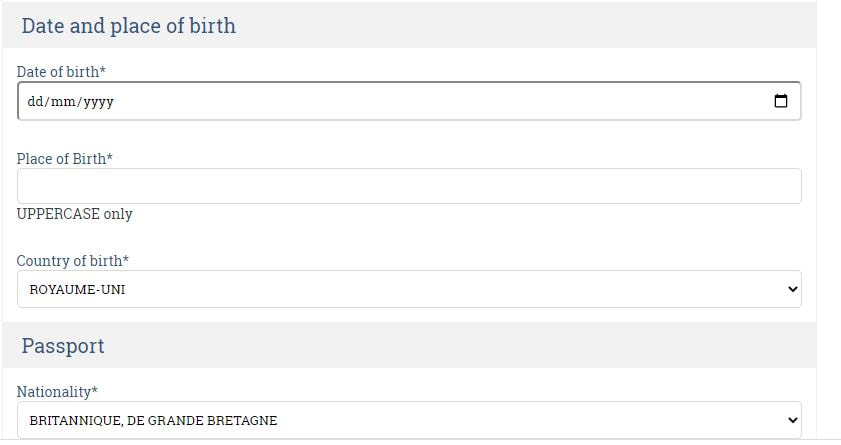
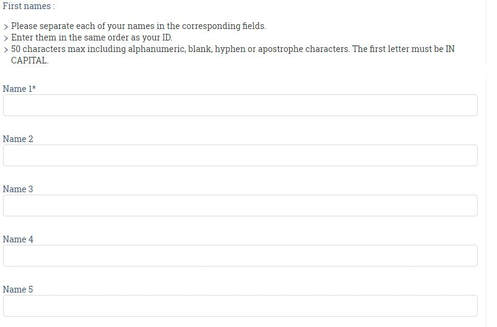
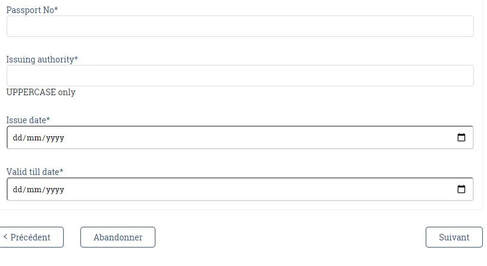
- On the following page you are asked to identify yourself, give your name and marital status, your date and place of birth, and your passport details.
- If you use a different name from your birth name - for example, your spouse's name - enter this as your Preferred name.
- Use the Issuing Authority details from your passport - for example, for a passport issued in the UK use UKPA, and for one issued in Paris use FCO.
|
|
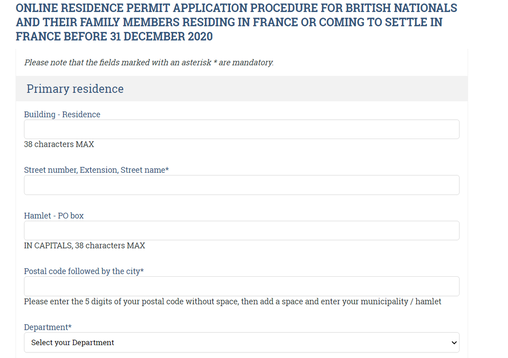
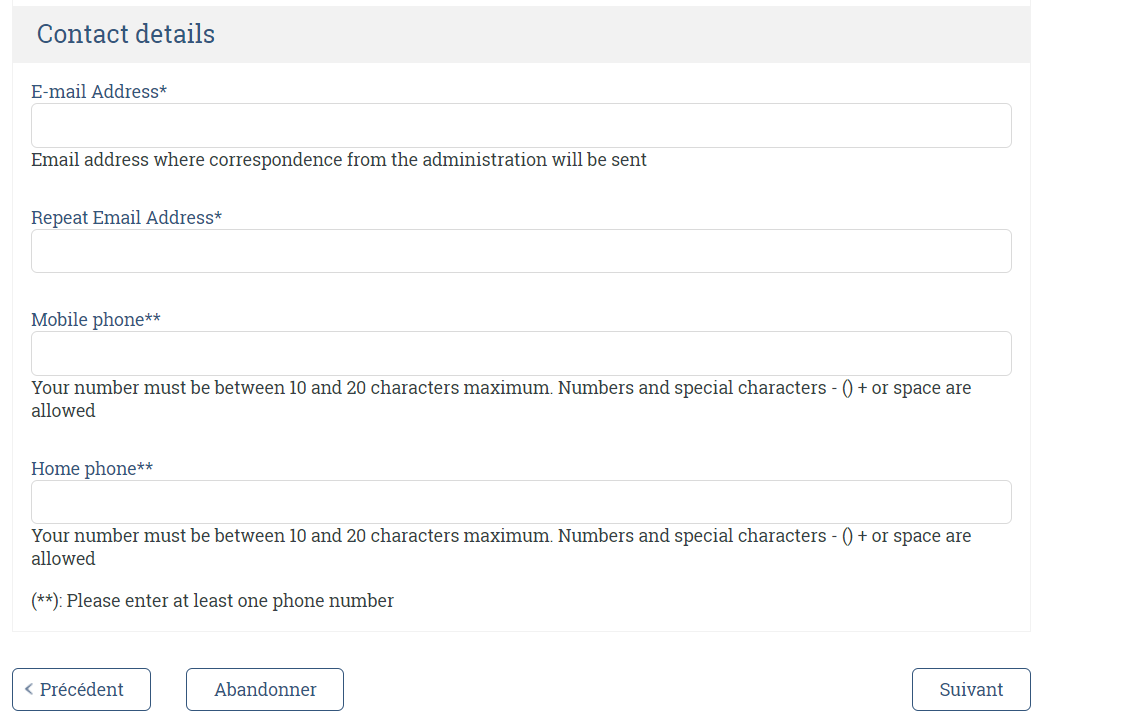
- Finally you're asked for your address details, email address and a phone number, either mobile or landline. An email address and at least one phone number are obligatory.
|
|
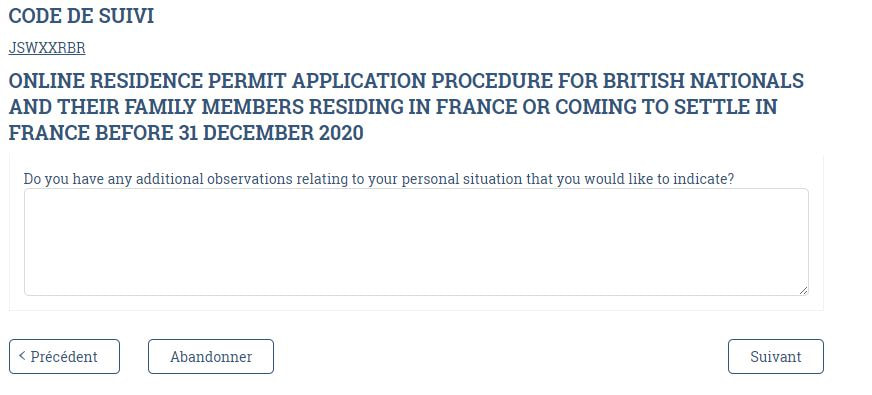
- The last box on the form asks whether you have any additional observations to make. This is where you should now add your reasons for not applying before the original deadline of 30 June 2021. You can also use this box if, for example, you would like to attend the préfecture at the same time as your spouse or another family member (add their names here); if you have mobility difficulties and would like your préfecture to get in touch to see if alternative arrangements can be made; or for any other comments on your application. Please write in French, otherwise your comments may not be fully understood. If your French isn't good enough you can use this site to translate what you want to say: www.deepl.com/en/translator.
- When you click on Suivant, you'll be taken to a page where you can see all the information you have input and verify whether it's correct. If so, you can go on and validate your application (press Valider); before you do this you'll have to answer a simple anti-spam question.
- You will receive (usually in under an hour) an email which is your attestation d'enregistrement and contains your unique application number. Keep this email very safe as you won't be able to get a copy. It is your proof that you have made your application. If you travel outside France after 31 December 2025 you'll need to take it with you until you receive your new card so that you are treated as a resident and not as a tourist when you return.
- In due course your préfecture will contact you with an appointment for fingerprinting and to present your photo - see this page for details.
- Your new card will then be sent to your home by post. You will receive a 5 year card.